Fitz Hugh Ludlow & American Cannabis Literature
"For the humble sum of six cents I might purchase an excursion ticket over all the earth" — a 21-year-old's cannabis experiment became the first American literary treatment of drug consciousness.
Before the Beats, before Aldous Huxley, before the counterculture made drug literature a genre, there was Fitz Hugh Ludlow — a Union College graduate who bought a vial of cannabis extract from a Poughkeepsie apothecary, swallowed it, and wrote a book that launched American psychoactive literature. He was twenty-one years old. He would be dead at thirty-four.
The Hasheesh Eater
The Hasheesh Eater published
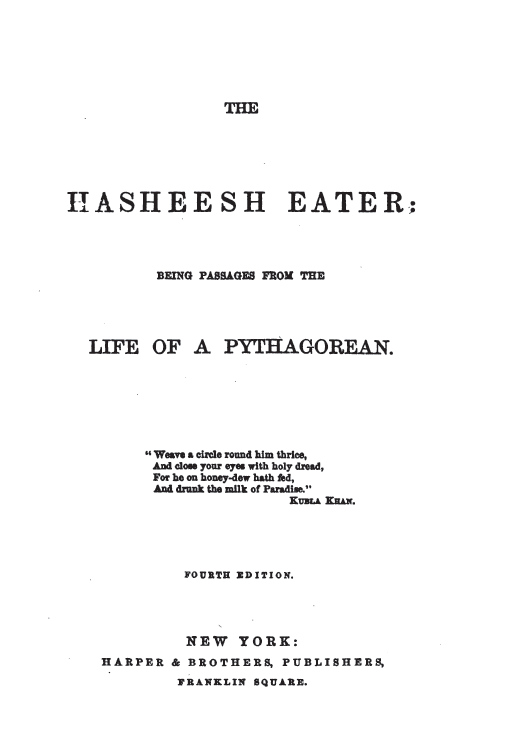
The Hasheesh Eater: Being Passages from the Life of a Pythagorean is published anonymously by Harper & Brothers. Ludlow is 21.
The Hasheesh Eater: Being Passages from the Life of a Pythagorean was published by Harper & Brothers in 1857, initially without its author's name on the title page. Ludlow was a recent graduate of Union College in Schenectady, New York — young, ambitious, literary, and already drawn to the intersection of chemistry and consciousness.
The book's genesis was simple. Ludlow had read Bayard Taylor's "The Vision of Hasheesh" (1854), a travel essay describing Taylor's experience with hashish in Damascus, and was curious enough to seek the drug himself. He obtained Tilden & Company cannabis extract from the apothecary in Poughkeepsie, New York — legally, over the counter, as one would buy any patent medicine.
"For the humble sum of six cents I might purchase an excursion ticket over all the earth; ships and dromedaries, tents and hospices were all contained in a box of Tilden's extract."
That sentence captures both the accessibility of cannabis in mid-nineteenth-century America and the literary ambition Ludlow brought to describing its effects. Six cents. Over the counter. No prescription, no age check, no moral panic. Cannabis was a commodity on the apothecary's shelf, between the laudanum and the cough syrup.
The De Quincey model
Ludlow modeled his book explicitly on Thomas De Quincey's Confessions of an English Opium-Eater (1821) — the founding text of literary drug autobiography. The parallel was deliberate: where De Quincey had mapped opium's architecture of pleasure and pain, Ludlow would do the same for cannabis. The literary-philosophical tone, the mix of ecstatic description and cautionary reflection, the self-conscious positioning of the author as both subject and scientist — all follow De Quincey's template.
The comparison was commercially shrewd. De Quincey was famous. Ludlow was unknown. By placing himself in De Quincey's tradition, Ludlow signaled to educated readers that The Hasheesh Eater was literature, not sensationalism — a distinction that mattered in an era when drug use carried curiosity rather than stigma among the reading classes.
The Bohemian circle
Ludlow's book generated enough attention to earn him a place in the literary culture of pre-Civil War New York. He joined the Bohemian circle that gathered at Pfaff's Tavern on Broadway — the underground beer hall where Walt Whitman held court alongside journalists, actors, and writers who defined themselves against the genteel literary establishment. Pfaff's was the closest thing antebellum New York had to a Left Bank café, and Ludlow fit its ethos: young, experimental, willing to write about experience that respectable literature avoided.
The hashish vogue that The Hasheesh Eater helped create was real but limited. John Hay — later Abraham Lincoln's private secretary and eventually U.S. Secretary of State — was reported to have "eaten Hasheesh and dreamed dreams" while at Brown University. The drug circulated among educated young men as a literary experiment, not a vice.
The Western journey
After the Civil War, Ludlow traveled west with the landscape painter Albert Bierstadt, whose monumental canvases of Yosemite and the Rocky Mountains were defining the visual iconography of the American West. Ludlow wrote dispatches from the journey, contributing to the popular literature of Western exploration. It was the most conventional phase of an unconventional career.
Morphine and the halfway house
Ludlow's later years traced a grimmer arc. After a riding injury, he developed a morphine addiction — a trajectory that was not unusual in an era when morphine was prescribed freely and addiction was poorly understood. His experience with dependency led him to a remarkable piece of advocacy: an 1867 essay in Harper's Magazine in which he proposed what he called a "halfway house" concept for addicts — a supervised residential environment where dependent individuals could withdraw from drugs with medical support.
The halfway house essay is arguably as significant as The Hasheesh Eater, though it is far less famous. Ludlow was writing from the inside of addiction, proposing institutional solutions that the medical establishment would not seriously consider for another hundred years. It was advocacy born of desperation, and it was ahead of its time.
Death in Geneva
Ludlow dies in Geneva
Fitz Hugh Ludlow dies of tuberculosis in Geneva, Switzerland, at the age of 34.
Ludlow died of tuberculosis in Geneva, Switzerland, on September 12, 1870. He was thirty-four years old. His death was not directly caused by drug use, but his health had been compromised by years of morphine dependency and the itinerant lifestyle of a freelance writer without steady income or institutional support.
Legacy
Ludlow's literary reputation faded quickly after his death, and The Hasheesh Eater went out of print for long stretches of the twentieth century. The book was rediscovered by the counterculture in the 1960s and has since been recognized as the first substantial American literary account of drug consciousness — a precursor to William Burroughs, Allen Ginsberg, and the psychedelic literature of the 1960s.
The arc of Ludlow's life — from six-cent curiosity to literary celebrity to morphine addiction to a visionary essay on recovery to death at thirty-four — compresses into a single biography the full cycle of American drug experience: access, experimentation, creation, dependency, and loss. He lived every phase of the story that drug policy would spend the next century trying to legislate.
For in-depth cannabis education, dosing guides, safety information, and research summaries, visit our partner site TryCannabis.org