Raphael Mechoulam — THC Discovery (1964), CBD & ECS
He rode five kilos of hashish home on a public bus. Isolated THC in 1964. Discovered anandamide in 1992. Published 440 papers across 60 years at Hebrew University. Should have won a Nobel Prize.
Born in Sofia, Bulgaria
Raphael Mechoulam is born in Sofia, Bulgaria, to a Sephardic Jewish family. His father, a physician, will survive a Nazi labor camp. The family emigrates to Israel in 1949.
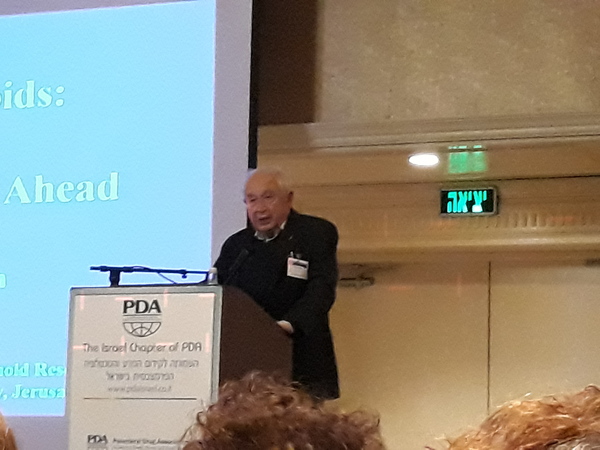
Raphael Mechoulam's biography begins in the catastrophe of 20th-century European Jewry and ends in the founding of an entire field of pharmacology. His father survived a Nazi labor camp. His family reached Israel in 1949, the year after independence. Mechoulam earned his PhD at the Weizmann Institute of Science in 1958 and completed a postdoctoral fellowship at the Rockefeller Institute in New York. He then returned to Israel and spent the next sixty years at the Hebrew University of Jerusalem, where he would identify the most important molecules in cannabis science.
The research question
Mechoulam's starting point was a simple observation: by the early 1960s, morphine had been isolated from opium and cocaine had been isolated from coca leaves, but no one had identified the active compound in cannabis. The most widely used illicit drug in the world was pharmacologically uncharacterized. Mechoulam set out to fill the gap.
The hashish on the bus
To conduct his research, Mechoulam needed cannabis. He requested five kilograms of confiscated hashish from the Israeli police. They gave it to him. He rode it home on a public bus — a detail he recounted in interviews for decades, to the amusement of interviewers and the retrospective horror of university compliance officers. The hashish was his raw material for the isolation work that followed.
Isolating CBD and THC
CBD isolated and characterized
Mechoulam and his colleagues isolate and characterize cannabidiol (CBD) — identifying its molecular structure. CBD will eventually prove to be the basis for Charlotte's Web, Epidiolex, and the entire CBD industry.
Delta-9-THC isolated
Mechoulam, Yechiel Gaoni, and Habib Edery isolate and synthesize delta-9-tetrahydrocannabinol (THC) — the primary psychoactive compound in cannabis. The work is published in the Journal of the American Chemical Society (JACS 1964, 86:1646-1647). This is the most important single paper in cannabis science.
The 1964 JACS paper is the founding document of modern cannabinoid chemistry. It identified the molecule responsible for cannabis intoxication, determined its structure, and synthesized it. For the first time, scientists knew exactly what cannabis did and which molecule did it. Every subsequent advance in cannabis pharmacology — medical applications, drug testing, receptor identification, the endocannabinoid system — flows from Mechoulam's 1964 isolation.
Mechoulam and his colleagues also identified CBG (cannabigerol) and THCA (tetrahydrocannabinolic acid) shortly afterward, mapping out the major cannabinoid family that would define the field for decades.
Anandamide and the endocannabinoid system
Anandamide discovered
Mechoulam, William Devane, and Lumír Hanuš discover anandamide — the first identified endocannabinoid, a molecule produced naturally by the human body that binds to the same receptors as THC. They name it from the Sanskrit word ananda, meaning "bliss."
The discovery of anandamide was arguably more significant than the isolation of THC itself. It revealed that the human body produces its own cannabis-like molecules — endocannabinoids — that bind to specific receptors throughout the brain and body. The endocannabinoid system, as it came to be known, is involved in pain modulation, appetite, mood, memory, immune function, and a range of other physiological processes.
The naming choice — ananda, Sanskrit for "bliss" — reflects Mechoulam's literary sensibility. A Bulgarian-Israeli chemist named an endogenous neurotransmitter after a Sanskrit concept. The word has become standard pharmacological terminology.
Sixty years at Hebrew University
Mechoulam spent his entire post-doctoral career at the Hebrew University of Jerusalem — sixty years of continuous research at a single institution. He published more than 440 scientific papers. He trained generations of cannabinoid researchers. He established Israel as the global center of cannabis science, a position it retains.
He was awarded the Israel Prize, the Rothschild Prize, and numerous international honors. He was frequently cited as a candidate for the Nobel Prize in Chemistry or Physiology. The Nobel never came — a fact that many in the field regard as an injustice shaped by the stigma surrounding cannabis research rather than by the quality of the science.
Death
Dies in Jerusalem at age 92
Raphael Mechoulam dies in Jerusalem. He was 92 years old. His discoveries — THC, CBD, anandamide, the endocannabinoid system — constitute the entire pharmacological foundation of modern cannabis science.
Assessment
Mechoulam's contribution to science is not a matter of debate. He identified the molecules that explain what cannabis does, discovered the biological system that explains why it works, and published the foundational papers that every subsequent cannabis researcher builds on. The field of cannabinoid pharmacology exists because of his work.
The informal consensus among cannabis scientists — "He should have won a Nobel Prize" — reflects a broader truth about the relationship between scientific merit and cultural stigma. Mechoulam spent sixty years studying a plant that most of the world's governments classified as having no medical value. His work proved otherwise. The governments were wrong. The science was right.
For in-depth cannabis education, dosing guides, safety information, and research summaries, visit our partner site TryCannabis.org