
Richard Nixon (1913–1994) — The Architect of Schedule I
Signed the Controlled Substances Act. Commissioned the Shafer report. Rejected its unanimous decriminalization recommendation. The White House tapes explain why. Cannabis policy is Nixon's most durable domestic legacy.
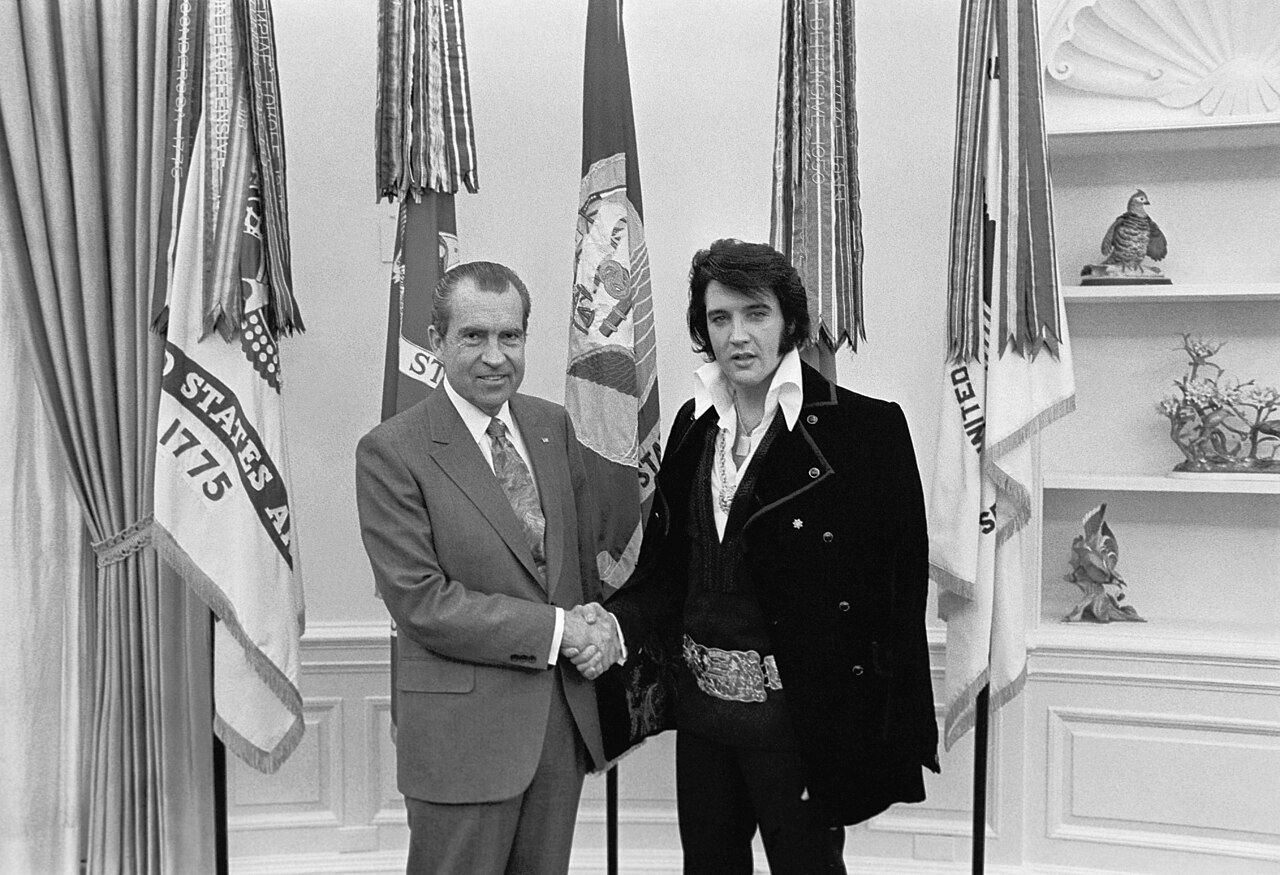
Born in Yorba Linda, California
Richard Milhous Nixon is born in Yorba Linda, California. He will become the 37th President of the United States, serving from 1969 to 1974.
Richard Nixon's presidency is remembered for Watergate, the opening to China, and the Vietnam War. But his most durable domestic-policy achievement is one he shares with no other president: the Controlled Substances Act. The drug scheduling system that Nixon signed into law in 1970 remains the framework under which cannabis is classified today — more than fifty years later, long after the political context that produced it has disappeared.
The Controlled Substances Act
Signs the Controlled Substances Act
Nixon signs the Comprehensive Drug Abuse Prevention and Control Act of 1970, which includes the Controlled Substances Act (Title II). Cannabis is placed in Schedule I — the most restrictive category, defined as having "a high potential for abuse," "no currently accepted medical use," and "a lack of accepted safety for use under medical supervision."
The CSA replaced a patchwork of earlier drug laws with a unified scheduling system. Schedule I, the most restrictive category, was intended as a temporary placeholder for drugs awaiting scientific evaluation. Cannabis was placed in Schedule I pending the results of a commission that Nixon himself would appoint. The placement was supposed to be temporary. It was not.
The Shafer Commission
Nixon commissions the National Commission on Marihuana and Drug Abuse
Nixon appoints the Shafer Commission, chaired by former Pennsylvania Governor Raymond Shafer — a Republican and Nixon ally. The commission is charged with studying marijuana and recommending policy.
Nixon chose Shafer precisely because he expected a reliable ally. Shafer was a Republican governor, a law-and-order conservative, and a Nixon supporter. The commission included members of Congress, physicians, and legal scholars. Nixon had every reason to expect a report that would validate his scheduling decision.
Shafer Commission report: unanimous decriminalization recommendation
The commission delivers its report, Marihuana: A Signal of Misunderstanding. It unanimously recommends that personal possession and non-profit distribution of small amounts of marijuana be decriminalized. The commission finds that marijuana does not cause physical dependence, does not lead to crime, and does not serve as a gateway to harder drugs.
The Shafer report was everything Nixon did not want. His own commission, led by his own appointee, unanimously concluded that criminal penalties for marijuana possession were disproportionate and counterproductive. The commission explicitly recommended decriminalization — not legalization, but the removal of criminal penalties for personal use.
Nixon rejected the report. He did not engage with its findings, dispute its evidence, or offer alternative analysis. He simply refused to implement its recommendations. Cannabis remained in Schedule I.
The tapes
The Nixon White House taping system, which would ultimately destroy his presidency, also preserved his private views on drug policy. The tapes reveal motivations that the public rhetoric obscured.
You know it's a funny thing, every one of the bastards that are out for legalizing marijuana is Jewish. What the Christ is the matter with the Jews, Bob? What is it about them that they always have to be pushing for every kind of thing?
Richard Nixon, conversation 505-4 with H.R. Haldeman, May 26, 1971 (White House tapes, National Archives)
Nixon's chief of staff, H.R. Haldeman, recorded in his diary that Nixon saw the drug issue through a racial lens. The diary entry confirms what the tapes suggest: drug policy was, for Nixon, inseparable from racial politics.
The framework that endured
Nixon resigned on August 9, 1974, over Watergate. He died on April 22, 1994. But the scheduling system he created outlasted everything else about his presidency. The Controlled Substances Act — and cannabis's placement in Schedule I — has survived every subsequent president, every reform movement, every state legalization initiative, and every scientific study demonstrating medical efficacy.
As of April 2026, 24 states and the District of Columbia have legalized adult-use cannabis. Forty states have medical cannabis programs. The FDA has approved a cannabis-derived medication (Epidiolex). Yet cannabis remains in Schedule I — the category Nixon defined as having "no currently accepted medical use." The scheduling has outlasted the evidence, the politics, and the president who created it.
Assessment
Nixon's cannabis policy was not based on science. His own commission told him so, and he rejected its findings. The White House tapes reveal that his drug policy was entangled with racial animus and political strategy. The Ehrlichman quote, if accurate, describes a deliberate decision to use drug enforcement as a tool of political and racial targeting.
What makes Nixon's cannabis legacy remarkable is not its origins — political calculations and racial politics are common enough in American policy history. What makes it remarkable is its durability. The temporary scheduling placeholder that Nixon created in 1970, pending the results of a commission whose recommendations he rejected, has outlasted the man, his presidency, and the political era that produced it. Cannabis policy is Richard Nixon's most durable domestic legacy.
For in-depth cannabis education, dosing guides, safety information, and research summaries, visit our partner site TryCannabis.org