
Cannabis in China 4000 Years Ago — Hemp & Shennong
Neolithic fiber, Han-dynasty paper, funerary braziers in the Pamirs — and a legendary emperor whose famous date belongs to the 20th century, not 2737 BCE.
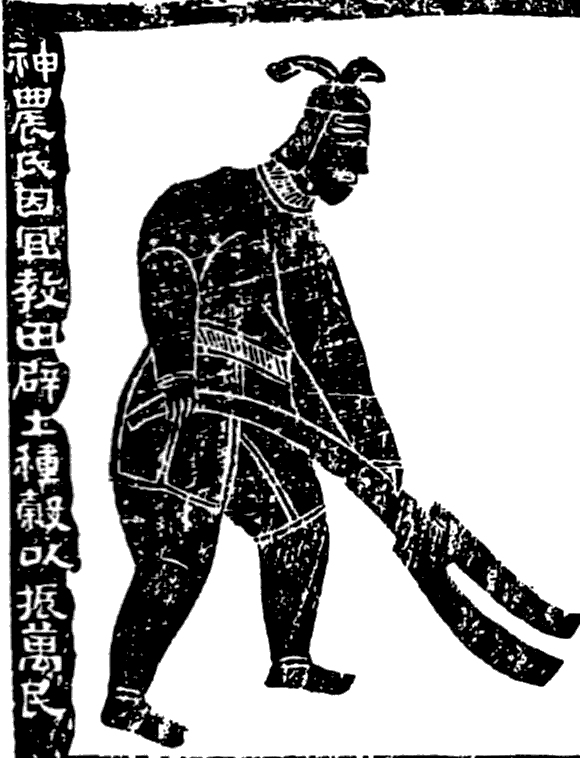
Cannabis sativa co-evolved with human agriculture in Central Asia, and its earliest documented use is Chinese. Hemp fiber, seed, and eventually paper made cannabis one of the most economically important plants in East Asian civilization for millennia before anyone recorded its psychoactive properties. But the story most often told about Chinese cannabis — that Emperor Shennong prescribed it in 2737 BCE — is a modern fabrication draped over a real but much later text.
Neolithic hemp: fiber first
The oldest material evidence of cannabis cultivation comes from the Yangshao culture of northern China, where hemp textiles date to roughly 7,000 years ago. Cord-impressed pottery from Taiwan suggests still earlier use — the fibers pressed into wet clay before firing leave unmistakable impressions of twisted hemp cordage.
The Chinese character ma (麻) encompassed hemp in all its forms: fiber for textiles, seed for food and oil, and — much later — medicine. For the Neolithic period, the evidence is overwhelmingly industrial. Cannabis was rope, cloth, and netting. The plant's psychoactive properties, if known at all, left no trace in the archaeological record of this era.
The Jirzankal braziers: first confirmed psychoactive use
Jirzankal Cemetery, eastern Pamirs
In 2019, a team led by Meng Ren and Nicole Boivin published findings in Science Advances identifying cannabinol (a THC breakdown product) on wooden braziers recovered from tombs at Jirzankal Cemetery. Gas chromatography confirmed that the cannabis burned in these funerary rituals had been deliberately selected for higher THC content than wild plants — the first scientific confirmation of intentional psychoactive cannabis use.
Separately, the Yanghai Tombs near Turpan yielded a 2,700-year-old burial containing 789 grams of cultivated, THC-dominant cannabis — a substantial personal cache interred with the dead. Together, Jirzankal and Yanghai establish that by the middle of the first millennium BCE, communities along the eastern Pamir trade routes were selecting cannabis for potency and incorporating it into ritual practice.
The Shennong Bencaojing: real text, legendary date
What the Shennong Bencaojing actually says about cannabis is itself significant. The text classifies ma among medicinal substances and notes that its fruit, taken in excess, "may make one behold ghosts" — an acknowledgment of psychoactive effects wrapped in the cautionary language typical of Han-era pharmacopoeia. This is genuine evidence of Chinese awareness of cannabis's mind-altering properties, but it dates to roughly two thousand years ago, not five.
Hua Tuo and mafeisan
Hua Tuo's cannabis-wine anesthetic
The physician Hua Tuo reportedly used mafeisan (麻沸散) — a powder dissolved in wine — as a surgical anesthetic. The name literally includes ma (hemp/cannabis). The claim is plausible but unverified: Hua Tuo's original formula does not survive, and later reconstructions are speculative.
If mafeisan did contain cannabis, Hua Tuo would represent one of the earliest documented uses of cannabis as a surgical anesthetic — a remarkable medical innovation. But the conditional matters. The formula is lost, and attributing modern pharmacological precision to a fragmentary historical record is exactly the kind of overreach this site aims to avoid.
Hemp and papermaking
Fangmatan hemp proto-paper
A fragment of hemp-based proto-paper from a tomb at Fangmatan predates the traditional attribution of papermaking to Cai Lun by nearly three centuries.
Cai Lun's standardized paper
The court eunuch Cai Lun is traditionally credited with standardizing papermaking using bark, hemp, rags, and fishnets. His innovation was process standardization, not the raw material — hemp fiber had been used in proto-paper for centuries.
Chinese papermaking depended on hemp fiber for centuries before and after Cai Lun. The Fangmatan fragment, dated to approximately 179 BCE, demonstrates that hemp-based writing surfaces existed well before Cai Lun formalized the technique. Paper would eventually transform not only Chinese civilization but — once the technology reached the Islamic world and then Europe — global literacy and governance.
What the Chinese record establishes
China's cannabis history is genuinely ancient and genuinely important. It does not need a mythical emperor to be impressive. The documented record establishes:
- ~7,000 years ago: Hemp textiles in the Yangshao culture — among humanity's oldest cultivated fibers.
- ~500 BCE: Deliberate selection of high-THC cannabis for funerary ritual at Jirzankal, confirmed by gas chromatography.
- ~179 BCE: Hemp proto-paper at Fangmatan, predating Cai Lun by three centuries.
- 1st–2nd century CE: The Shennong Bencaojing documents cannabis's psychoactive effects and medicinal uses.
- ~200 CE: Hua Tuo's plausible but unverified use of cannabis-wine anesthetic.
That is a record spanning millennia, touching fiber, paper, medicine, and ritual. It does not require inflation.
For in-depth cannabis education, dosing guides, safety information, and research summaries, visit our partner site TryCannabis.org