
Harry Anslinger & the Federal Bureau of Narcotics
Thirty-two years, five presidents, and a pivot from alcohol to marijuana to heroin to communism — the career of America's first drug czar, sourced to what he actually did rather than what the internet claims he said.
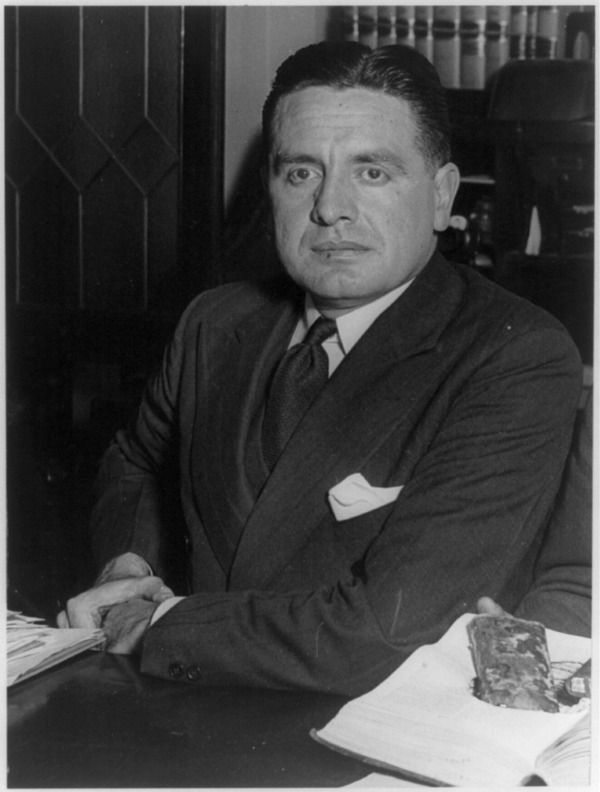
Harry Jacob Anslinger served as commissioner of the Federal Bureau of Narcotics from 1930 to 1962 — the longest tenure of any federal drug-enforcement chief in American history. He shaped US drug policy across the Great Depression, World War II, the early Cold War, and the dawn of the counterculture. His influence on cannabis prohibition is immense. But the popular account of Anslinger — a racist zealot who invented the marijuana menace from whole cloth on day one — is not quite what the documentary record shows.
Early career: Prohibition and diplomacy
Born in Altoona, Pennsylvania
Harry Jacob Anslinger is born in central Pennsylvania, far from the southwestern borderlands where cannabis prohibition would take root.
Anslinger entered federal service through the Prohibition Unit of the Treasury Department, enforcing alcohol laws during the 1920s. He also served in consular postings abroad, where he developed expertise in international narcotics diplomacy — work that would culminate in what historians call the "Anslinger Accord," his framework for international drug-control cooperation. His early career was focused on opiates and alcohol, not cannabis.
The Federal Bureau of Narcotics
FBN created by the Porter Act
The Federal Bureau of Narcotics is established within the Treasury Department. Treasury Secretary Andrew Mellon appoints Anslinger as its first commissioner.
The Mellon appointment is one of the most discussed details of Anslinger's career. Anslinger's wife, Martha Kind Denniston, was related to the Mellon family — Andrew Mellon was her uncle by marriage. Jack Herer and other cannabis advocates have treated this connection as proof of a DuPont-Mellon conspiracy to destroy the hemp industry. The scholarly assessment is more cautious. John McWilliams, Anslinger's most thorough academic biographer, described the family connection as "probable but not ironclad" as a factor in the appointment. Mellon had other reasons to want a reliable administrator: the Bureau of Prohibition was a notorious source of corruption, and Anslinger had a reputation for competence.
1930–1934: cannabis as regional nuisance
This is the fact most often omitted from popular accounts. Anslinger did not arrive at the FBN as a marijuana crusader. For his first four years as commissioner, he actively downplayed the cannabis issue, treating it as a minor regional concern — primarily a border-state problem — that did not merit federal attention. His agency was focused on opiates, primarily heroin and opium.
What changed was not the drug. What changed was the political landscape.
The pivot: 1933–1936
Prohibition ends
The Twenty-first Amendment repeals alcohol prohibition. The federal enforcement apparatus — and the public appetite for anti-vice crusades — needs a new target.
The repeal of Prohibition in December 1933 created an existential crisis for federal law enforcement. The Bureau of Prohibition was dissolved. The FBN, technically a separate agency within Treasury, survived — but its mandate was narrow (opiates) and its budget was perpetually under threat. Anslinger needed a reason for Congress to keep funding his bureau.
Between 1935 and 1936, Anslinger reversed his position on cannabis. The man who had spent four years telling states that marijuana was their problem began building a case for federal action. He compiled the "Gore Files" — a collection of violent-crime case studies that he attributed to marijuana use. He cultivated newspaper contacts who would print Bureau-supplied stories. He drafted legislation.
The timing is important. Anslinger's marijuana crusade began after Prohibition ended, not before. The bureaucratic-survival thesis — that Anslinger turned to marijuana because his agency needed a new mission — is supported by the chronology in a way that the conspiracy theories (Hearst, DuPont, Mellon) are not.
The war years and the Cold War pivot
During World War II, cannabis enforcement was a secondary priority. The government actually encouraged hemp cultivation for the war effort ("Hemp for Victory," 1942). Anslinger focused on preventing diversion of military morphine supplies and managing wartime opiate logistics.
After the war, Anslinger pivoted again — this time toward the Cold War. His rhetoric evolved to match the new political environment:
Marijuana leads to pacifism and Communist brainwashing.
Harry Anslinger, testimony supporting the 1948 United Nations Protocol on narcotic drugs
This was a remarkable rhetorical inversion. In the 1930s, Anslinger had argued that marijuana caused violence and sexual aggression. By 1948, he was arguing that it caused passivity and susceptibility to Communist influence. The drug had not changed. The political environment had.
The gateway theory
Anslinger begins claiming that marijuana is a "stepping stone" to heroin addiction — the forerunner of the gateway-drug hypothesis that would dominate American drug-policy rhetoric for decades.
By 1951, Anslinger had added yet another argument: marijuana as a gateway to heroin. This was the third distinct theory of marijuana's danger — violence (1930s), Communist susceptibility (1940s), heroin gateway (1950s) — each calibrated to the anxieties of its era. The contradictions between these theories apparently troubled neither Anslinger nor Congress.
Thirty-two years
Anslinger retires
After 32 years as FBN commissioner, serving under Presidents Hoover, Roosevelt, Truman, Eisenhower, and Kennedy, Anslinger steps down. He continues as US representative to the United Nations Narcotics Commission.
Anslinger's tenure — 1930 to 1962 — is extraordinary by any standard. He outlasted five presidents. He built the template for federal drug enforcement that the DEA would inherit. He shaped international drug-control treaties that remain in force today. And he did all of this from a small bureau within the Treasury Department, with a budget that never exceeded a few million dollars.
Assessing Anslinger
The popular internet version of Anslinger — a frothing racist who launched the drug war from pure bigotry — is a caricature, though not a groundless one. Anslinger did use racialized language. He did exploit racial fears. He did compile misleading case files. A December 4, 1934 memo held at the FDR Presidential Library contains his use of a racial slur in official correspondence.
But the documented record shows something more complex and, arguably, more troubling than a simple bigot: a skilled bureaucratic operator who adapted his arguments to whatever political environment would keep his agency funded and his authority expanding. The violence narrative, the Communist narrative, the gateway narrative — each was deployed when it was politically useful and quietly abandoned when it was not.
Anslinger was not a fool, and he was not merely a racist. He was a bureaucrat who understood power, and he built an enforcement apparatus that outlasted him by six decades and counting. Understanding that — rather than reducing him to a collection of unverifiable quotes — is essential to understanding how cannabis prohibition actually works.
For in-depth cannabis education, dosing guides, safety information, and research summaries, visit our partner site TryCannabis.org