
Reefer Madness (1936) & Propaganda Films Debunked
Exploitation films, not government propaganda — and the surprise that Anslinger tried to suppress the most famous one. The real story of Reefer Madness and its imitators.
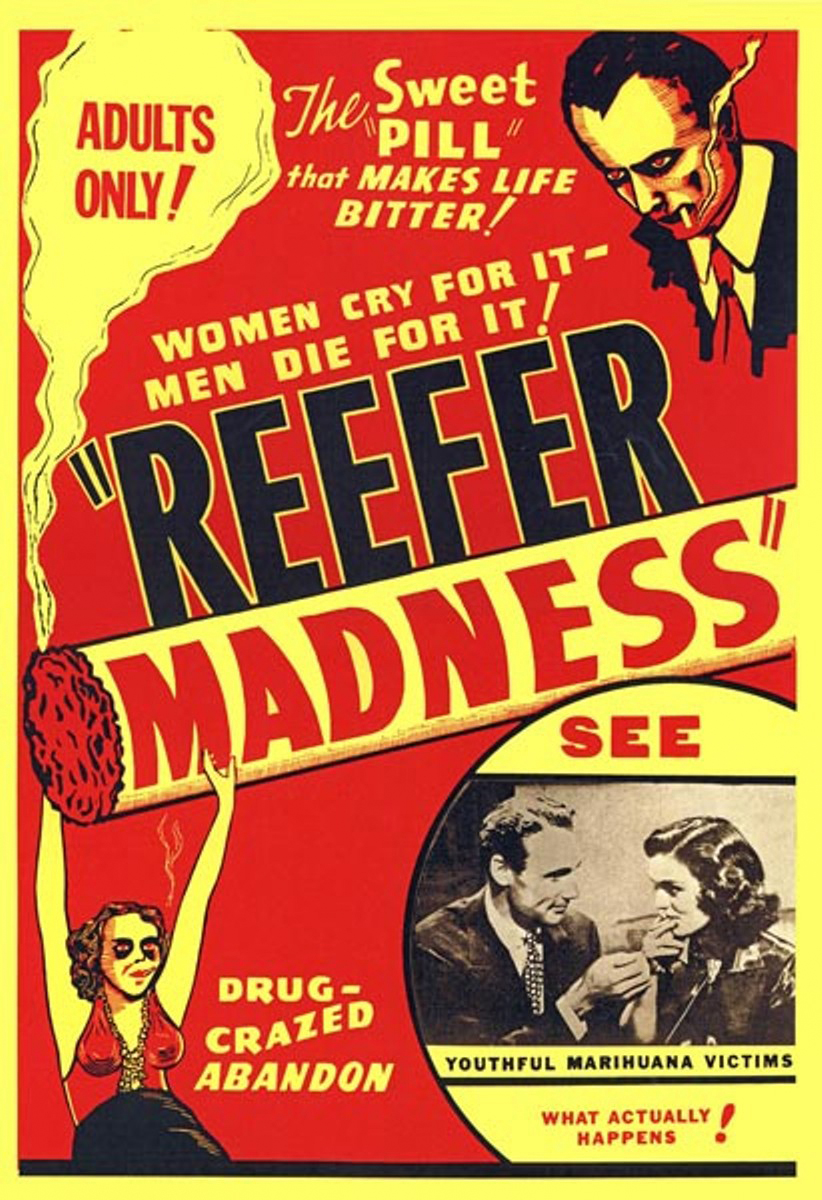
The propaganda films of the 1930s and 1940s are the most visible artifacts of the marijuana-panic era. Reefer Madness alone has become a cultural shorthand for government drug hysteria. But the standard account — that these films were produced by or for the federal government as anti-marijuana propaganda — is largely wrong. They were exploitation films, produced by independent operators to make money, and the Federal Bureau of Narcotics was not always pleased about them.
Reefer Madness (1936)
Tell Your Children / Reefer Madness
Directed by Louis Gasnier, produced by George Hirliman as Tell Your Children. Recut and redistributed by exploitation-film veteran Dwain Esper under the title Reefer Madness. Now in the public domain — copyright was never renewed.
Reefer Madness was originally titled Tell Your Children. It was directed by Louis Gasnier, a French-born filmmaker who had been working in Hollywood since the silent era, and produced by George Hirliman. The film was a low-budget cautionary tale about teenagers destroyed by marijuana — hit-and-run accidents, murder, suicide, and descent into madness, all triggered by a few puffs from a joint.
The film was acquired and recut by Dwain Esper, one of the most prolific exploitation-film distributors of the era. Esper retitled it Reefer Madness and marketed it on the exploitation circuit — theaters that specialized in lurid content presented under a veneer of moral education. The "educational" framing was a legal strategy: films that claimed to warn the public about social dangers received more lenient treatment from censorship boards than outright sensationalism.
Anslinger refused endorsement
This is the least-known fact about Reefer Madness: Harry Anslinger did not approve of it. According to Wayne Hall's 2026 analysis in Addiction, Anslinger refused to endorse the film and actively attempted to suppress its distribution. The Bureau of Narcotics wanted to control the anti-marijuana narrative, and a lurid exploitation film — however anti-marijuana its message — was not the kind of controlled communication Anslinger preferred. The Bureau's propaganda was channeled through newspaper contacts, magazine articles, and congressional testimony, not through grindhouse cinema.
The second life: midnight movies
The film would have disappeared entirely had it not been rediscovered in the early 1970s. Keith Stroup, founder of NORML (the National Organization for the Reform of Marijuana Laws), located a print at the Library of Congress in 1971 or 1972 for approximately $297. The film's copyright had never been renewed, placing it in the public domain.
Robert Shaye of New Line Cinema recognized the film's potential as camp comedy and began screening it on the midnight-movie circuit. Audiences who came to laugh at the absurdity of its anti-marijuana message turned Reefer Madness into an ironic cult classic — the opposite of its intended effect. The film became the most effective piece of pro-legalization propaganda in history, precisely because it was so bad.
Marihuana (1936)
Marihuana
Directed by Dwain Esper. Features a plot involving marijuana, skinny-dipping, and a character named "Burma." Now in the public domain.
Dwain Esper directed Marihuana himself, applying the same exploitation formula he used when redistributing Reefer Madness. The film followed a young woman drawn into marijuana use, leading to skinny-dipping, pregnancy, and eventually drug dealing. The "Burma" plot — named for one of its characters — pushed the boundaries of what censorship boards would tolerate. Like Reefer Madness, it is now in the public domain.
Assassin of Youth (1937)
Assassin of Youth
Directed by Elmer Clifton. Title borrowed directly from Anslinger's American Magazine article. Now in the public domain.
The title was taken directly from Anslinger's July 1937 American Magazine article, "Marijuana: Assassin of Youth," co-written with Courtney Ryley Cooper. The film, directed by Elmer Clifton, capitalized on the publicity surrounding the Marihuana Tax Act hearings. It is another exploitation production masquerading as public education. Public domain.
Devil's Harvest (1942)
Devil's Harvest
A later entry in the anti-marijuana exploitation cycle, featuring the memorable detail of marijuana concealed in hot-dog buns. Public domain.
Devil's Harvest extended the exploitation cycle into the wartime era, featuring what has become one of the genre's most cited details: marijuana concealed inside hot-dog buns. The film was a minor production, but it demonstrates that the exploitation formula persisted well after the initial wave of anti-marijuana legislation had passed.
She Shoulda Said No! (1949)
She Shoulda Said No!
Directed by Sam Newfield, starring Lila Leeds — who had been arrested with Robert Mitchum for marijuana possession in 1948. Producer Kroger Babb falsely claimed Treasury Department sponsorship.
The last significant entry in the anti-marijuana exploitation cycle arrived in 1949, directed by Sam Newfield and starring Lila Leeds. Leeds was not a random casting choice — she had been arrested alongside actor Robert Mitchum for marijuana possession in 1948, a scandal that made national headlines. The film capitalized on Leeds's notoriety, casting her in a fictionalized version of her own tabloid story.
Producer Kroger Babb, another exploitation-circuit veteran, falsely claimed that the film had Treasury Department sponsorship. It did not. This was the same marketing strategy used across the exploitation genre: claiming government endorsement to give lurid content a veneer of civic purpose.
Anslinger's actual propaganda
While the exploitation films grabbed attention, Anslinger's real propaganda operation was more effective and less visible. His primary vehicles were not films but print media:
- "Marijuana: Assassin of Youth" — Anslinger's article in American Magazine, July 1937, co-written with Courtney Ryley Cooper. This was the Bureau's flagship public communication, timed to coincide with the Tax Act hearings.
- Reader's Digest condensation — A condensed version appeared in Reader's Digest in February 1938, reaching the magazine's massive middle-class readership.
- Hearst newspapers — The Hearst chain, particularly the Los Angeles Examiner, ran Bureau-supplied stories with headlines like "Murder Weed Found Up and Down Coast" (January 5, 1933) and "Marihuana Makes Fiends of Boys in 30 Days."
- Planted magazine stories — Howard Becker documented that 10 of 17 marijuana articles in popular magazines between 1937 and 1939 acknowledged FBN assistance in their preparation.
This print campaign — working through established, credible media outlets — was far more effective at shaping public opinion than any exploitation film. The exploitation movies reached grindhouse audiences; the Reader's Digest reached millions of homes. The newspaper stories reached daily readers across the country. Anslinger understood that controlling the message through respectable channels mattered more than anything projected on a screen.
The ironic legacy
Every one of the major anti-marijuana exploitation films is now in the public domain, freely available online. They are watched today almost exclusively as comedy — artifacts of a moral panic so extreme that they provoke laughter rather than fear. Reefer Madness has been adapted as a stage musical, parodied in television shows, and screened at cannabis-legalization fundraisers.
The films' journey from cautionary tales to camp classics to pro-legalization irony is itself a piece of cultural history. The propaganda failed not because it was refuted but because it was so exaggerated that it refuted itself. When audiences can see that the claims are absurd, the medium becomes the counter-message. Anslinger was right to be wary of the exploitation filmmakers. They made his cause look ridiculous — just not during his lifetime.
For in-depth cannabis education, dosing guides, safety information, and research summaries, visit our partner site TryCannabis.org