
Reagan Drug Policy — Just Say No & the 1986 Act
Len Bias, the Anti-Drug Abuse Act, the 100:1 crack disparity, "Just Say No," and DARE — the most expensive drug-education program in American history, which every major study found did not work.
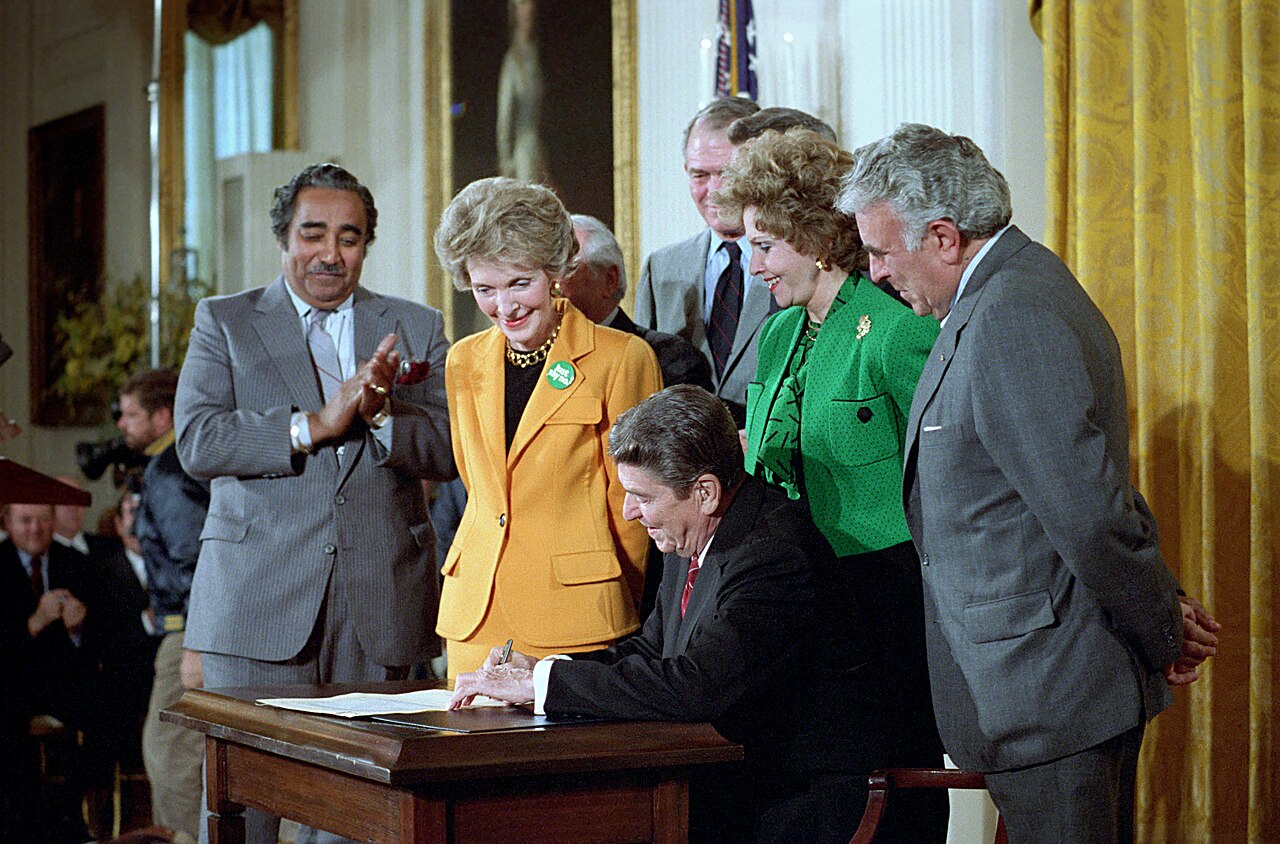
The Reagan administration escalated the War on Drugs from a Nixon-era political strategy into a mass-incarceration machine. The tools were mandatory minimums harsher than anything the Boggs Act had imposed, a public-relations campaign built on a first lady's slogan, and a school-based drug-education program that became one of the most thoroughly debunked interventions in the history of public health. The catalyst for the worst of it was the death of a single college basketball player.
Len Bias and the Anti-Drug Abuse Act of 1986
Len Bias dies of cocaine overdose
Len Bias, a 22-year-old All-American basketball player from the University of Maryland, dies of a cocaine overdose two days after being drafted by the Boston Celtics. His death triggers a legislative panic.
Bias's death was a genuine tragedy. What followed was a legislative catastrophe. Congress, in the grip of an election-year drug panic, drafted and passed the Anti-Drug Abuse Act of 1986 (Pub. L. 99-570) without committee hearings — an extraordinary procedural shortcut for legislation that would reshape the federal criminal justice system.
The Act reimposed mandatory minimum sentences that the Controlled Substances Act of 1970 had partially rolled back. For cannabis, the thresholds were severe:
- 100 kilograms: 5-year mandatory minimum
- 1,000 kilograms: 10-year mandatory minimum
The Act also created the infamous 100:1 crack-to-powder cocaine sentencing disparity: 5 grams of crack cocaine triggered the same mandatory minimum as 500 grams of powder cocaine. Since crack was used disproportionately in Black communities and powder cocaine in white ones, the disparity functioned as a racial sentencing multiplier embedded in the statute itself.
Reagan joint address on drugs
President Ronald Reagan and First Lady Nancy Reagan deliver a joint televised address from the White House, framing drug abuse as a national emergency and calling for a "national crusade" against drugs.
Anti-Drug Abuse Act of 1988
Congress passes a second omnibus drug law creating the Office of National Drug Control Policy (ONDCP) — the "drug czar" position — and further expanding federal enforcement powers.
"Just Say No"
Nancy Reagan's "Just Say No" campaign originated in 1982 at Longfellow Elementary School in Oakland, California, when a student asked the First Lady what to do if someone offered her drugs. "Just say no," she replied. The phrase became the centerpiece of the Reagan administration's demand-side drug policy.
Nancy Reagan traveled over 100,000 miles, visiting 55 cities in 28 states to promote the campaign. It generated enormous media coverage and bipartisan goodwill. It also coincided with a significant decline in adolescent drug use: senior cannabis use dropped from approximately 50% to 12% between 1978 and 1991, according to the Monitoring the Future survey.
Whether "Just Say No" caused that decline is another question. The downward trend in adolescent drug use began before the campaign launched, coincided with broader cultural shifts, and was influenced by the parent movement that had organized independently of the Reagan White House. Attributing causation to a slogan, rather than to the constellation of social forces operating simultaneously, is precisely the kind of post-hoc reasoning that serious policy analysis exists to prevent.
DARE: the program that did not work
DARE launched in Los Angeles
The Drug Abuse Resistance Education program is founded by Los Angeles Police Chief Daryl Gates — the same chief who told the Senate that casual drug users "ought to be taken out and shot." DARE places uniformed police officers in elementary-school classrooms to teach anti-drug curricula.
DARE expanded rapidly, eventually reaching 75% of American school districts and operating in 43 countries. It was enormously popular with parents, administrators, and police departments. It was also, by every rigorous measure, ineffective.
The most comprehensive meta-analysis of DARE found that it had no statistically significant effect on drug use.
Ennett et al., "How Effective Is Drug Abuse Resistance Education? A Meta-Analysis of Project DARE Outcome Evaluations," <em>American Journal of Public Health</em> 84(9), 1994
The Ennett meta-analysis found an effect size "essentially zero." Subsequent studies confirmed and extended the finding:
- Lynam et al. (1999) — "No Effects at 10-Year Follow-Up." Students who completed DARE were no less likely to use drugs a decade later than students who had not.
- GAO-03-172R (January 2003) — The Government Accountability Office reviewed DARE evaluations and found "no significant differences in illicit drug use" between DARE students and controls.
- West & O'Neal, AJPH (2004) — A further meta-analysis confirming the null result.
Some studies went further, finding that DARE graduates were more likely to use drugs than non-participants — possibly because the program's exaggerated warnings, when contradicted by students' later real-world experience, destroyed the credibility of all drug-safety messaging.
The Reagan legacy
The Reagan era's contribution to drug policy was not innovation but escalation. Mandatory minimums were not new — the Boggs Act had created them in 1951. School-based drug education was not new. Even the "drug czar" concept had precursors. What Reagan did was scale these tools to industrial proportions and embed them in a cultural narrative — the "drug-free America" — that made questioning their effectiveness equivalent to supporting drug use.
The results, measured in human terms, were catastrophic. The federal prison population doubled during the 1980s. State prison populations surged as states adopted their own mandatory-minimum schemes modeled on the federal structure. And the racial disparities that the Boggs Act had amplified were locked into statute by the 100:1 crack disparity — a ratio so indefensible that it took Congress twenty-four years to reduce it, and even then only to 18:1.
For in-depth cannabis education, dosing guides, safety information, and research summaries, visit our partner site TryCannabis.org