
Harry J. Anslinger (1892-1975) — 32 Years of Prohibition
Born in Altoona, Pennsylvania. Thirty-two years as America's first drug czar. Five presidents. The architecture of cannabis prohibition — built on racial propaganda, bureaucratic survival, and a willingness to change the argument whenever the political climate shifted.
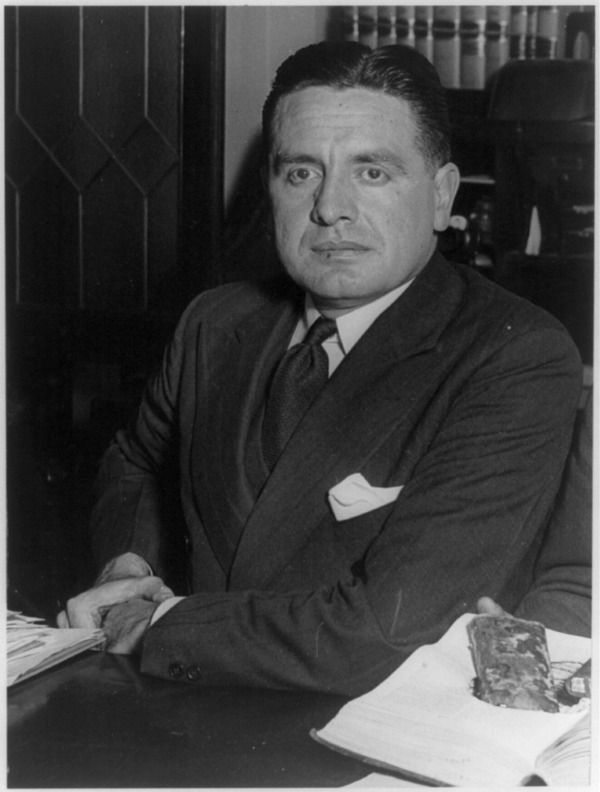
Born in Altoona, Pennsylvania
Harry Jacob Anslinger is born in central Pennsylvania to Swiss immigrant parents. He grows up in railroad country, far from the southwestern borderlands where cannabis prohibition would take root.
Harry Jacob Anslinger's path to becoming America's most consequential drug-policy official ran through the Pennsylvania Railroad police, the Consular Service, and the Prohibition Unit of the Treasury Department. He was a bureaucrat by training and temperament — competent, politically attuned, and skilled at institutional survival. These qualities would define his 32-year career as commissioner of the Federal Bureau of Narcotics more than any personal conviction about marijuana.
The FBN and the Mellon connection
Appointed FBN commissioner
Treasury Secretary Andrew Mellon appoints Anslinger as the first commissioner of the newly created Federal Bureau of Narcotics. Anslinger's wife, Martha Kind Denniston, is related to the Mellon family — Andrew Mellon is her uncle by marriage.
The Mellon-Anslinger family connection is one of the most discussed details in cannabis history. Jack Herer treated it as proof of a conspiracy linking DuPont, Mellon, and Anslinger in a coordinated plot to destroy hemp. The scholarly assessment is more cautious. John McWilliams, Anslinger's most thorough academic biographer, described the family connection as probable but not ironclad as a factor in the appointment. Mellon had practical reasons to want a reliable administrator: the Prohibition Bureau had been a notorious source of corruption.
The pivot: from dismissal to crusade
The most important fact about Anslinger's early tenure is the one most often omitted from popular accounts. As late as 1929, Anslinger stated publicly that cannabis "could not be compared with opium" as a problem requiring federal attention. For his first four years as commissioner, he consistently treated marijuana as a regional nuisance best handled by state and local authorities. He resisted calls for federal cannabis legislation.
What changed was not the drug. What changed was the end of alcohol Prohibition on December 5, 1933. The repeal created an existential crisis for federal enforcement agencies. Anslinger needed a new mission to justify his bureau's budget. Between 1935 and 1936, he reversed his position entirely — the man who had spent four years dismissing marijuana began building the case for federal prohibition.
The Gore Files and racial propaganda
Anslinger compiled the "Gore Files" — a collection of violent-crime case studies attributed to marijuana use. The most famous was the Victor Licata case: a Tampa teenager who murdered his family with an axe in October 1933. Anslinger used the case as proof that marijuana drove users to homicidal violence.
The documented record shows that Anslinger knew Licata had a history of mental illness. Tampa police records noted a pre-existing psychiatric condition. Anslinger used the story anyway, because it was useful. The case was a propaganda instrument, not a medical finding.
Anslinger's racial propaganda was systematic. His public statements and Bureau-supplied newspaper stories consistently framed marijuana as a threat carried by Mexican immigrants and Black jazz musicians, corrupting white youth and white women. This was not incidental rhetoric — it was the core of the Bureau's public messaging strategy.
The legislative record
Marihuana Tax Act
Anslinger's Bureau produces the Marihuana Tax Act, which passes Congress after two hours of committee hearings and 92 seconds of floor debate. The American Medical Association opposes the bill; Congress ignores its objections.
Boggs Act
Anslinger supports the Boggs Act, which establishes mandatory minimum sentences for drug offenses and begins linking marijuana to heroin as a "stepping stone."
Narcotic Control Act (Daniel Act)
The Daniel Act increases mandatory minimums further. A first offense for marijuana sale can now carry a sentence of five to twenty years.
Across two decades of legislation, Anslinger built an escalating framework of criminal penalties that would culminate in the Controlled Substances Act of 1970 — signed eight years after his retirement but built on the architecture he created.
Billie Holiday
Anslinger's pursuit of jazz singer Billie Holiday is one of the darkest chapters of his tenure. Holiday, who struggled with heroin addiction, was targeted by the FBN in what appears to have been a personal campaign by Anslinger. She was arrested, convicted, and stripped of her cabaret card — ending her ability to perform in New York clubs. She died on July 17, 1959, in Metropolitan Hospital in New York, under arrest, with a federal agent posted at her hospital door.
International legacy
UN Single Convention on Narcotic Drugs
Anslinger's final major achievement: the international treaty that globalized the prohibitionist framework he had built domestically. The Single Convention classified cannabis alongside opiates and required signatory nations to restrict its use. The treaty remains in force today.
Final years
Retires as FBN commissioner
After 32 years under five presidents — Hoover, Roosevelt, Truman, Eisenhower, and Kennedy — Anslinger steps down. He continues as US representative to the United Nations Narcotics Commission.
Dies in Altoona, Pennsylvania
Harry Anslinger dies in the same city where he was born, 83 years earlier. His papers are held at Penn State University.
Anslinger's papers at Penn State University remain one of the most important archival collections for understanding American drug policy. They document a career that shaped not only domestic law enforcement but the international drug-control framework that remains in force six decades later.
Assessment
The popular version of Anslinger — a frothing racist who invented the marijuana menace from pure bigotry — is a caricature, though not a groundless one. The documented record shows something more complex: a skilled bureaucratic operator who adapted his arguments to whatever political environment would keep his agency funded. The violence narrative in the 1930s, the Communist susceptibility narrative in the 1940s, the gateway drug narrative in the 1950s — each was deployed when politically useful and quietly abandoned when it was not.
Understanding Anslinger as a bureaucrat who understood power, rather than reducing him to a collection of viral quotes, is essential to understanding how cannabis prohibition actually works.
For in-depth cannabis education, dosing guides, safety information, and research summaries, visit our partner site TryCannabis.org