
Marihuana Tax Act of 1937 — Two Hours of Hearings
Two hours of hearings. Ninety-two seconds of floor debate. The AMA opposed it. A congressman told the House floor the AMA supported it. That was a lie. FDR signed the bill anyway.
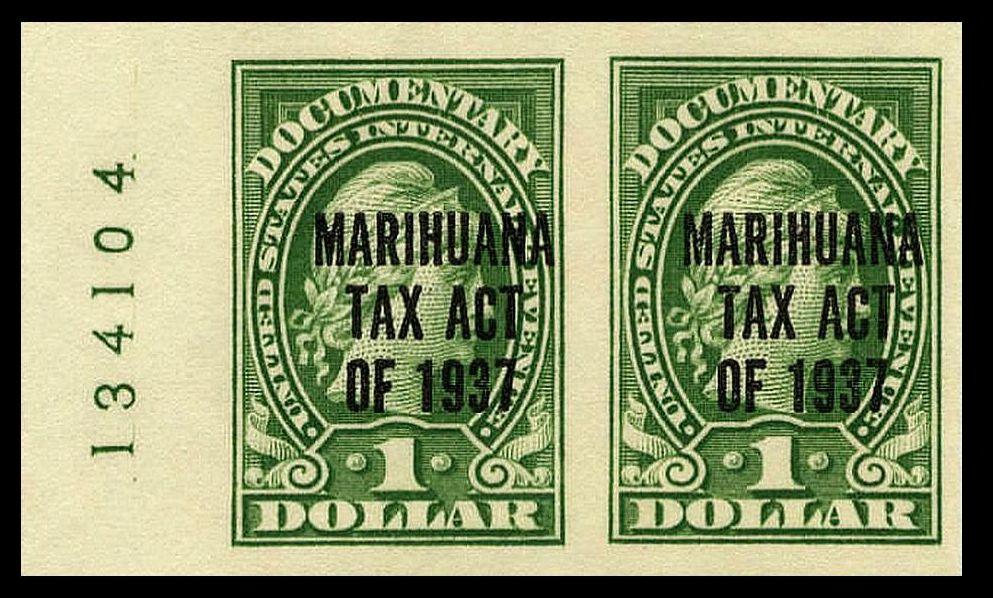
The Marihuana Tax Act of 1937 (Pub. L. 75-238, 50 Stat. 551) was the first federal law effectively criminalizing cannabis in the United States. It did not technically ban the plant — it imposed a tax structure so punitive that legal compliance was nearly impossible for unauthorized users. The authorized tax was $1 per ounce. The unauthorized tax was $100 per ounce — roughly $2,100 in 2024 dollars. The distinction between "tax" and "ban" was a legal fiction, and everyone involved knew it.
Drafting and introduction
The bill was drafted by Clinton Hester, an attorney in the Treasury Department's General Counsel's office. Hester modeled it on the Harrison Narcotics Tax Act of 1914 and the National Firearms Act of 1934 — both of which used the federal taxing power as a vehicle for regulation that might otherwise exceed congressional authority.
Bill introduced
Representative Robert L. Doughton of North Carolina introduces the Marihuana Tax Act in the House. Doughton chairs the House Ways and Means Committee, ensuring the bill a smooth path to hearings.
The bill was introduced on April 14, 1937, by Representative Robert L. Doughton of North Carolina, chairman of the House Ways and Means Committee. Doughton's chairmanship gave the Bureau of Narcotics a critical advantage: the committee chairman controlled the hearing schedule, the witness list, and the floor debate.
The hearings: approximately two hours
Ways and Means Committee hearings
The committee holds hearings on the bill across multiple sessions. Total substantive testimony amounts to roughly two hours — an extraordinary brevity for legislation that would effectively criminalize a plant used in hundreds of medical preparations.
The hearings ran from April 27 to May 4, 1937, but the total substantive testimony amounted to roughly two hours. Anslinger testified at length, presenting the Gore Files and the Bureau's case for federal action. Several other witnesses supported the bill. The opposition came from a single source.
The AMA opposition: Dr. Woodward
On May 4, 1937, Dr. William C. Woodward, the American Medical Association's legislative counsel, appeared before the committee. His testimony (hearing transcript, pp. 87–121) was the most substantive challenge the bill faced — and the committee's response to it reveals more about the legislative process than the bill itself.
Woodward made three primary objections:
- No Bureau of Prisons evidence: Woodward pointed out that the Bureau of Prisons had not been consulted and had provided no evidence that marijuana was a significant factor in federal criminal cases.
- No Bureau of Education evidence: The Children's Bureau and the Office of Education had not been consulted about the alleged threat to youth that the Bureau of Narcotics claimed.
- Secrecy: The Treasury Department had drafted the bill "in secret for two years" without informing the medical profession — a point Woodward found extraordinary given that the bill would affect every physician who prescribed cannabis preparations.
We cannot understand yet, Mr. Chairman, why this bill should have been prepared in secret for two years without any intimation, even, to the profession, that it was being prepared.
Dr. William C. Woodward, AMA legislative counsel, May 4, 1937 (hearing transcript, pp. 87–121)
The committee's response to Woodward was hostile. Representative John Dingell of Michigan delivered the most quoted rejoinder:
If you want to advise us on legislation, you ought to come here with some constructive proposals, rather than criticism, rather than trying to throw obstacles in the way of something that the Federal Government is trying to do. It has not been done in secret. It has been done in the most open way that I have ever seen legislation prepared... If you cannot do any better than you have done, you had better go home.
Representative John Dingell (D-MI) to Dr. Woodward, May 4, 1937
Woodward did not go home. He followed up with a letter dated July 10, 1937, to Senator Pat Harrison, chairman of the Senate Finance Committee, reiterating the AMA's objections. The letter had no effect.
The lie on the House floor
The bill was redrafted as H.R. 6906 and brought to the House floor. What happened next is one of the most documented instances of legislative deception in American drug-policy history.
When a member of the House asked whether the American Medical Association supported the bill, Representative Fred Vinson — later Chief Justice of the United States — told the House that the AMA "support this bill 100 percent."
This was not a misunderstanding. This was not a difference of interpretation. The AMA had sent its legislative counsel to testify against the bill. Woodward had spent hours objecting to it. He had submitted written objections. Vinson's statement was false, and it was made on the floor of the House of Representatives to secure passage of federal legislation.
The House passed the bill by voice vote. Professor Charles Whitebread, in his analysis of the legislative history, timed the total floor debate at "one minute and thirty-two seconds."
Senate passage and signing
Senate passage
The Senate passes the Marihuana Tax Act with no recorded vote. No significant debate occurs in the upper chamber.
FDR signs the Marihuana Tax Act
President Franklin D. Roosevelt signs Pub. L. 75-238 into law. The act takes effect October 1, 1937.
The Senate passed the bill without a recorded vote. There is no indication of significant debate. President Roosevelt signed it on August 2, 1937, and the act took effect on October 1, 1937.
The tax structure
The act imposed two tiers of taxation:
- $1 per ounce for authorized handlers — registered physicians, pharmacists, and manufacturers who completed the required paperwork and paid annual registration fees.
- $100 per ounce for unauthorized transfers — effectively a prohibitive penalty disguised as a tax. At 1937 prices, this was roughly equivalent to $2,100 per ounce in modern dollars.
The act also required extensive record-keeping, order forms, and registration with the Bureau of Internal Revenue. The compliance burden was deliberately structured to make legal cannabis commerce impractical for all but the most determined authorized users — and to expose unauthorized users to criminal prosecution for tax evasion.
Death and legacy
Leary v. United States
The Supreme Court strikes down the Marihuana Tax Act as unconstitutional. Timothy Leary successfully argued that the act's registration requirement compelled self-incrimination in violation of the Fifth Amendment.
Controlled Substances Act
Congress replaces the invalidated Tax Act with the Controlled Substances Act, which places marijuana in Schedule I — the most restrictive category, reserved for drugs with "no currently accepted medical use" and a "high potential for abuse."
The Marihuana Tax Act survived for 32 years until the Supreme Court struck it down in Leary v. United States (1969). Timothy Leary had been convicted under the act for possession; his attorneys argued that the registration requirement forced him to incriminate himself in violation of the Fifth Amendment. The Court agreed unanimously.
Congress responded not by decriminalizing cannabis but by passing the Controlled Substances Act of 1970, which placed marijuana in Schedule I alongside heroin and LSD. The Tax Act's transparent legal fiction — that it was a revenue measure rather than a prohibition — was abandoned in favor of outright criminalization under the commerce power. Cannabis moved from an unconstitutional tax regime to the most restrictive scheduling category in federal law, where it would remain for more than half a century.
For in-depth cannabis education, dosing guides, safety information, and research summaries, visit our partner site TryCannabis.org